
Troubleshooting Low Pump Flow: How to Diagnose and Fix Reduced Pump Performance
A pump that isn’t delivering its expected flow rate is more than an inconvenience. It’s a signal that something in the system has changed, degraded, or failed. Left unaddressed, low flow can cascade into process disruptions, equipment damage, overheated motors, and unplanned shutdowns that cost far more than the repair itself. Effective troubleshooting low pump flow requires a systematic approach that starts with the most likely causes, works through the system methodically, and avoids the common mistake of replacing expensive components before confirming the actual root cause.
This guide walks you through the full diagnostic process, covering suction-side issues, discharge-side restrictions, internal pump problems, and system-level factors that reduce flow, along with the corrective actions for each.
Table of Contents
- 1 How to Approach a Low Flow Problem
- 2 Suction-Side Causes of Low Pump Flow
- 3 Discharge-Side Causes of Low Pump Flow
- 4 Internal Pump Causes of Low Flow
- 5 System-Level Factors That Reduce Flow
- 6 A Step-by-Step Diagnostic Sequence
- 7 Frequently Asked Questions
- 8 Restore Full Performance Before Small Problems Become Big Ones
How to Approach a Low Flow Problem
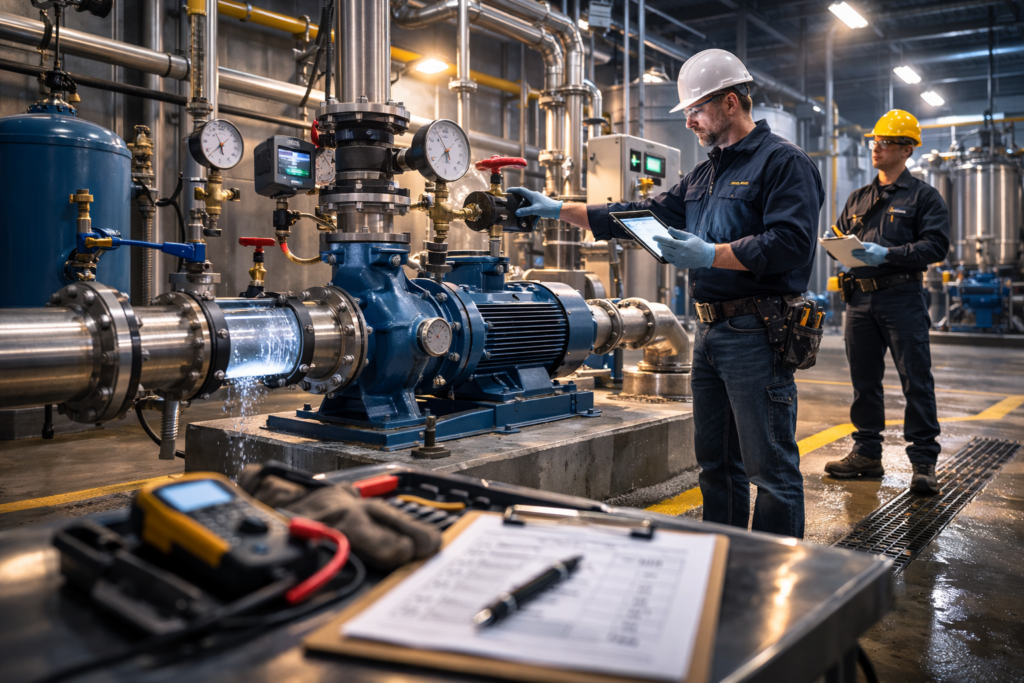
Before pulling out tools or ordering parts, take a step back and gather information. The answers to a few key questions will narrow your diagnosis significantly and prevent wasted time.
When did the flow decrease? A sudden drop in flow points to a discrete event like a valve left partially closed, a blockage, or a component failure. A gradual decline over weeks or months suggests wear, fouling, or a slowly developing system change.
Has anything in the system changed recently? New piping, added equipment, adjusted valve positions, a replacement impeller, a different fluid, or a change in operating temperature can all affect flow. Even changes that seem unrelated to the pump itself can shift the system curve enough to reduce output.
What type of pump are you working with? The diagnostic path for a centrifugal pump differs meaningfully from a positive displacement pump. Centrifugal pumps are sensitive to suction conditions, system resistance, and impeller condition. Positive displacement pumps are more affected by internal clearances, seal integrity, and bypass or relief valve settings.
Are there instrumentation readings available? Suction pressure, discharge pressure, motor amperage, vibration levels, and temperature data all provide objective clues that supplement visual inspection. If your system has gauges or monitoring equipment, read them before you start disassembling anything.
Suction-Side Causes of Low Pump Flow
The suction side of the pump system is the first place to investigate in the majority of low flow cases, particularly with centrifugal pumps. If the pump cannot draw fluid in efficiently, it cannot push it out at full capacity.
Insufficient NPSH (Net Positive Suction Head)
Every centrifugal pump requires a minimum amount of pressure at the suction inlet to operate without cavitation. When the available NPSH drops below the pump’s required NPSH, vapor bubbles form inside the pump, reducing hydraulic performance and causing the characteristic crackling or gravel-like noise associated with cavitation.
Common reasons for insufficient NPSH include a suction source level that has dropped (lower tank level, lower reservoir level, or a falling water table), increased fluid temperature that raises the vapor pressure, a clogged or restricted suction strainer, excessive friction loss in the suction piping due to undersized pipe, too many fittings, or a long suction run, and operating the pump at a flow rate higher than the system was designed to support.
Fix: Verify the suction source level, check and clean the suction strainer, confirm that the fluid temperature is within the expected range, and review the suction piping for restrictions or design inadequacies. If the system is inherently NPSH-limited, reducing the pump speed, lowering the pump closer to the fluid source, or increasing the suction pipe diameter may be necessary.
Air Entrainment or Loss of Prime
A centrifugal pump that ingests air loses its ability to develop full pressure and flow. Even a small amount of air leaking into the suction line can significantly degrade performance. Sources of air ingestion include leaking suction pipe joints, fittings, or valve packing, a vortex forming in the suction source at low liquid levels, a damaged or improperly installed mechanical seal, and an improperly primed pump that never fully evacuated air from the casing at startup.
Fix: Inspect all suction-side connections for leaks. A common field test is to apply a soapy water solution or shaving cream to joints and flanges while the pump is running and watch for bubbles being drawn inward. Verify the liquid level in the suction source is high enough to prevent vortexing. Confirm the pump was properly primed before operation, and check the mechanical seal for air ingestion.
Clogged Suction Strainer or Foot Valve
Strainers, filters, and foot valves on the suction line protect the pump from debris, but they also become flow restrictions when they foul. A partially clogged strainer can reduce flow gradually enough that the decline isn’t noticed until performance has dropped significantly.
Fix: Isolate the pump and clean or replace the suction strainer element. Establish a regular inspection and cleaning interval based on the fluid cleanliness and the rate of fouling observed. If the foot valve is stuck partially closed or has a broken flapper, replace it.
Discharge-Side Causes of Low Pump Flow
If the suction side checks out clean, move to the discharge side of the system. Anything that increases the resistance the pump has to push against will reduce the flow rate a centrifugal pump delivers.
Partially Closed or Obstructed Valve
This is one of the most common and most overlooked causes of low flow. A discharge valve, isolation valve, or control valve that has been inadvertently left partially closed, has failed in a throttled position, or has a buildup of scale or debris on the seat will restrict flow.
Fix: Walk the piping from the pump discharge to the point of delivery and verify that every valve is in the correct position. Inspect control valves for proper operation and confirm that automated valves are receiving the correct signal and responding as expected.
Blocked or Scaled Piping
Over time, mineral scale, corrosion products, biological growth, and other deposits can accumulate on the interior walls of discharge piping, gradually reducing the effective diameter and increasing friction losses. This is particularly common in systems handling hard water, cooling tower water, or fluids with a tendency to precipitate solids.
Fix: Inspect piping at accessible points for evidence of buildup. Pressure readings taken at multiple points along the discharge line can help identify the location of an obstruction. Chemical cleaning, mechanical pigging, or pipe replacement may be required depending on the severity and type of fouling.
Excessive System Head
If the total system resistance (static head plus friction losses) has increased beyond what the pump was designed to handle, the pump will operate at a reduced flow point on its performance curve. System head can increase due to piping modifications, added equipment (heat exchangers, filters, or spray nozzles), elevated discharge tank levels, or increased pipe roughness from aging and fouling.
Fix: Compare the current system conditions to the original design. If the system has changed, you may need to re-evaluate whether the current pump is still sized correctly for the duty. A system curve analysis overlaid on the pump curve will show exactly where the pump is operating relative to its design point.
Internal Pump Causes of Low Flow
When both the suction and discharge sides of the system check out, the problem is likely inside the pump itself.
Worn Impeller
Impeller wear is one of the most common causes of gradual flow decline in centrifugal pumps, especially in applications that handle abrasive fluids or slurries. As the impeller vanes erode, the pump loses its ability to impart energy to the fluid, and both flow and pressure drop.
Fix: Remove and inspect the impeller. Compare its dimensions and vane profile to the original specifications. If wear is significant, replace the impeller. In slurry service, impeller wear is expected and should be planned for as a routine maintenance item.
Worn Wear Rings
Wear rings maintain a tight clearance between the rotating impeller and the stationary pump casing. As these rings wear, internal recirculation increases, meaning the pump is re-pumping fluid that has already passed through the impeller rather than delivering it to the discharge. The pump appears to run normally from the outside, but actual delivered flow to the system decreases.
Fix: Measure wear ring clearances and compare to manufacturer specifications. Most pump manufacturers provide maximum allowable clearances. When the clearance exceeds the recommended limit, replace the wear rings. This is one of the highest-return maintenance actions for restoring flow in a centrifugal pump.
Damaged or Incorrect Impeller
A chipped, cracked, or eroded impeller will produce lower flow and pressure than a new one. Additionally, if an impeller was replaced during a previous maintenance event with the wrong diameter or a different trim, the pump’s output may not match the original design. Reverse rotation due to incorrect motor wiring will also produce dramatically reduced or zero flow.
Fix: Verify the impeller is the correct size and part number for the pump and application. Confirm rotation direction matches the arrow on the pump casing. Replace any impeller that shows physical damage.
Internal Bypass or Recirculation
In positive displacement pumps, worn internal clearances, a leaking bypass valve, or a relief valve set too low can allow fluid to recirculate inside the pump without being delivered to the discharge. The pump runs, the motor draws current, but the actual output to the system is reduced.
Fix: Check the bypass and relief valve settings. Inspect internal clearances (gear teeth, lobes, screws, or pistons depending on the pump type) for wear. In diaphragm pumps, check the diaphragm for rupture or fatigue, and inspect check valves for proper seating.
System-Level Factors That Reduce Flow
Sometimes the pump and its immediate piping are fine, but the broader system is the problem.
Running Multiple Pumps on a Common Header
When multiple pumps discharge into a shared header, the interaction between them can reduce individual pump output. If one pump is significantly stronger than the others, it can back-pressure the weaker pumps, reducing their contribution to the system. Improper check valve sizing or placement can compound this issue.
Fix: Review the system design to ensure pumps are properly matched and that check valves prevent reverse flow. Evaluate whether the header and branch piping are sized adequately for the combined flow.
Variable Frequency Drive (VFD) Settings
If the pump is controlled by a VFD, the drive speed directly determines the pump’s output. A VFD that has been inadvertently set to a reduced speed, is receiving an incorrect input signal, or is operating in a fault-limited mode will restrict pump performance.
Fix: Check the VFD display for current speed, any active faults, and the input signal from the process controller. Verify that the speed setpoint matches the intended operating condition.
Increased Fluid Viscosity
If the fluid being pumped has become more viscous due to a temperature drop, a formulation change, or contamination, a centrifugal pump will deliver less flow and require more power. Positive displacement pumps handle viscosity changes more predictably but will still show increased pressure drop in the piping system, which can reduce effective delivery.
Fix: Verify fluid properties against the original design assumptions. If viscosity has increased permanently, the pump may need to be re-rated or the system redesigned to accommodate the changed conditions.
A Step-by-Step Diagnostic Sequence
When you’re standing in front of a pump that isn’t delivering, follow this order to work through the problem efficiently.
Step 1: Check suction and discharge pressure gauges. Compare readings to baseline or design values. A low suction pressure points to suction-side issues. A high discharge pressure relative to flow suggests a discharge restriction.
Step 2: Inspect the suction strainer and source level.
Step 3: Walk the discharge piping and verify all valve positions.
Step 4: Check for air leaks on the suction side.
Step 5: Listen for cavitation noise at the pump.
Step 6: Check the VFD speed and motor amperage.
Step 7: If all external factors check out, shut down the pump and inspect internal components: impeller, wear rings, seals, and (for positive displacement pumps) check valves, diaphragms, and internal clearances.
This sequence moves from the easiest and most common causes to the more involved, ensuring you don’t tear apart a pump only to discover that someone left a valve half closed.
Frequently Asked Questions
What is the most common cause of low pump flow?
The most common causes are suction-side restrictions (clogged strainers, low source levels, air leaks) and partially closed discharge valves. These account for the majority of low flow complaints in both residential and industrial settings and should always be checked before investigating internal pump components.
How do I know if my pump is cavitating?
Cavitation typically produces a distinctive crackling, rattling, or gravel-like noise at the pump. Other indicators include fluctuating discharge pressure, reduced flow, pitting damage on the impeller surfaces, and excessive vibration. Low suction pressure readings confirm insufficient NPSH as the underlying cause.
Can a worn impeller cause low flow?
Yes. As an impeller erodes, its ability to transfer energy to the fluid decreases, resulting in lower flow and lower discharge pressure. Impeller wear is especially common in pumps handling abrasive fluids, slurries, or water with high solids content. Inspection and replacement restore the pump to its original performance curve.
Why is my pump running but not pumping water?
A pump that runs but produces little or no flow has likely lost its prime (air-bound), has a completely blocked suction line, is running in reverse rotation, has a severely worn impeller or internal components, or has a discharge line that is fully blocked. Start by checking for air in the casing, verifying rotation direction, and inspecting the suction path.
How do worn wear rings affect pump performance?
Worn wear rings increase the internal clearance between the impeller and the casing, allowing fluid to recirculate from the high-pressure discharge side back to the low-pressure suction side inside the pump. The pump appears to operate normally, but delivered flow to the system is reduced. Replacing wear rings is one of the most cost-effective ways to restore centrifugal pump performance.
Should I increase pump speed to compensate for low flow?
Increasing speed can temporarily restore flow, but it does not address the root cause. If the low flow is caused by internal wear, a blockage, or a system change, running the pump faster will increase energy consumption, accelerate wear, and potentially push the pump into an unsafe operating region. Diagnose and fix the underlying problem before adjusting speed.
Restore Full Performance Before Small Problems Become Big Ones
Low pump flow is a symptom, not a diagnosis. The cause could be as simple as a throttled valve or as involved as a worn impeller that needs replacement. Either way, the systematic approach outlined in this guide gets you to the answer faster and with less wasted effort.
Need help diagnosing a flow problem you can’t resolve in the field? Contact a qualified pump service provider or distributor who can perform a comprehensive pump assessment, including performance curve testing, vibration analysis, and internal inspection. Restoring your pump to full output today prevents the cascading failures and unplanned downtime that cost exponentially more tomorrow.