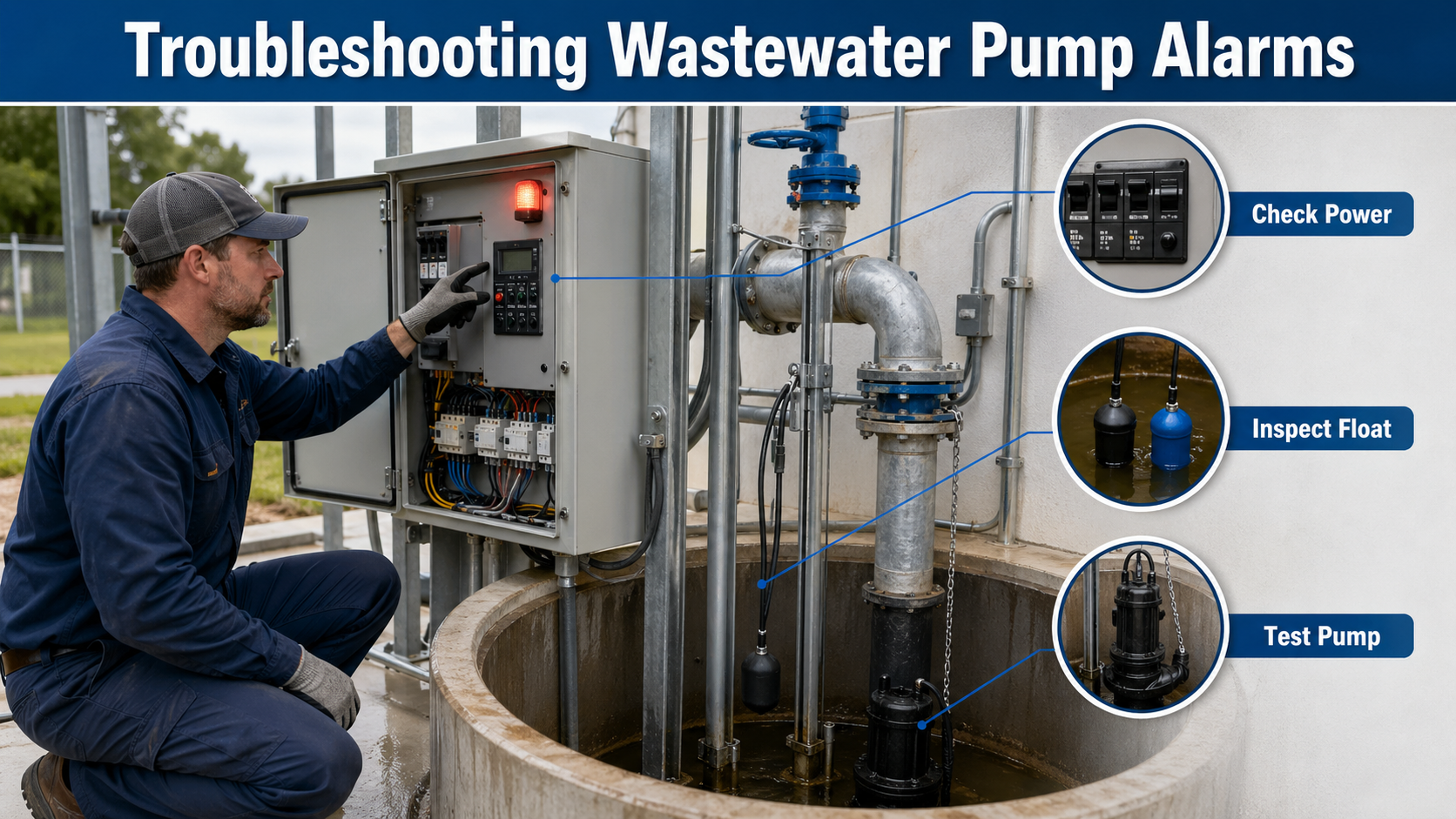
Troubleshooting Wastewater Pump Alarms: What Each One Means and How to Respond
A wastewater pump alarm is not a suggestion — it is the system telling you something has already gone wrong and the window to prevent a worse outcome is closing. Operators and maintenance staff who understand troubleshooting wastewater pump alarms can distinguish a nuisance condition from an emergency, respond appropriately, and prevent a single fault from cascading into a wet well overflow, a regulatory violation, or a destroyed motor.
Wastewater pump alarms are discrete signals generated by the control panel when a sensor, protection circuit, or level device detects a condition outside the system’s normal operating parameters. Each alarm type has a specific cause profile and a corresponding response sequence. Treating every alarm as identical — or worse, silencing alarms without investigating them — is how minor, recoverable faults become major, expensive failures. Here is a systematic guide to the most common alarms in municipal and commercial wastewater pump systems and exactly how to troubleshoot each one.
Table of Contents
- 1 Responding to Wastewater Pump Alarms Quickly Is What Separates a Recoverable Fault from a Regulatory Event
- 2 A High Water Alarm Is the Most Urgent Wastewater Pump Alert You Will Encounter
- 3 Pump Failure and Thermal Overload Alarms Mean the Pump Has Stopped Running
- 4 What Does a Seal Failure Alarm Mean on a Submersible Pump?
- 5 How Do You Diagnose a Wastewater Pump That Runs But Fails to Move Water?
- 6 Frequently Asked Questions About Wastewater Pump Alarm Troubleshooting
- 6.1 How do I tell the difference between a nuisance alarm and a real fault?
- 6.2 Can I reset a tripped thermal overload without a service call?
- 6.3 What causes a phase loss alarm on a wastewater pump?
- 6.4 How often should lift station alarms be tested?
- 6.5 Does Pump Professionals provide troubleshooting support for wastewater pump systems?
- 7 Understanding Your Alarms Is the Difference Between a Maintenance Call and an Emergency
Responding to Wastewater Pump Alarms Quickly Is What Separates a Recoverable Fault from a Regulatory Event
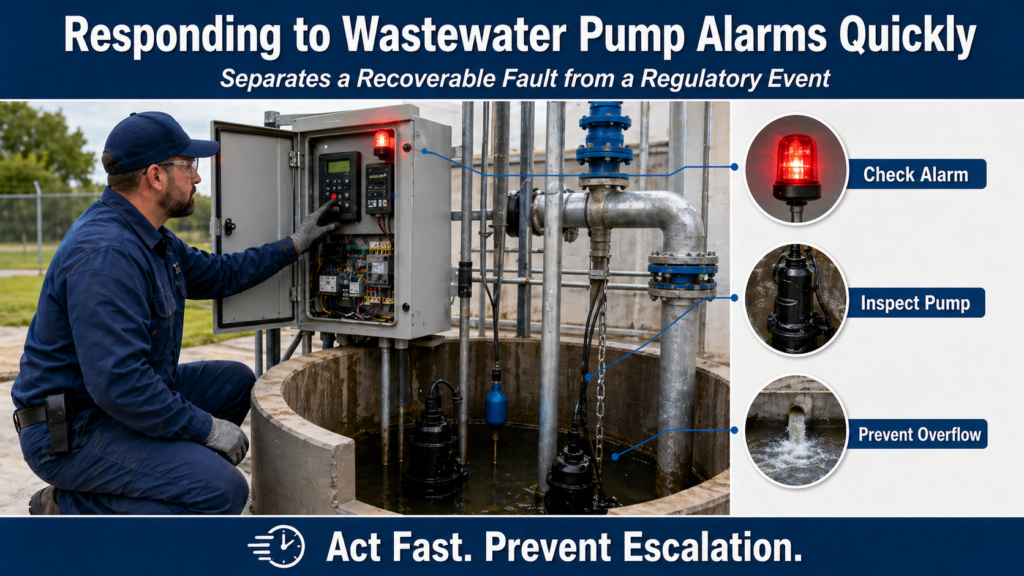
The consequences of a delayed or incorrect alarm response scale rapidly with time. A pump fault that trips at 2:00 a.m. and goes unaddressed until a site visit at 8:00 a.m. gives the wet well six hours to fill — which is more than enough time to overflow in any system with meaningful inflow. Municipal wastewater overflows trigger mandatory reporting obligations under NPDES permits and can result in significant fines. For commercial and industrial operators, an overflow event carries its own liability and remediation costs that dwarf the cost of timely alarm response.
Effective alarm response depends on two things working together: a monitoring system that delivers alarm notifications to a person who can act on them — whether through audible/visual indicators at the site, a remote dialer, or a SCADA telemetry connection — and an operator who understands what each alarm means and what the correct first response is. The second element is what this guide addresses.
A High Water Alarm Is the Most Urgent Wastewater Pump Alert You Will Encounter
The high water alarm activates when the wet well level rises above the high water float or transducer setpoint — a level set above the lag pump-on point in a duplex system, indicating that neither pump running simultaneously is keeping pace with inflow, or that pumping has stopped entirely. It is the most time-critical alarm in the system because the wet well has limited capacity above the high water setpoint before overflow occurs.
Most Common Causes of a High Water Alarm
- Both pumps offline simultaneously — power failure, dual thermal overload trip, or back-to-back mechanical failures in a duplex system
- Inflow exceeding combined pump capacity — storm-related infiltration/inflow event overwhelming the design flow, particularly in older or deteriorated collection systems
- Force main blockage or closed isolation valve — pumps are running but discharge is restricted, so the wet well continues to fill despite pump operation
- Float or level sensor malfunction — a failed or stuck float may have prevented pumps from starting at their normal setpoints, allowing the level to rise undetected until the high water float was reached
- Control panel fault — a failed alternating relay, blown control fuse, or damaged circuit board that prevented pump start commands from being issued
Immediate Response Steps
- Confirm whether pumps are running — check the control panel run lights and ammeter (if installed) to determine if current is being drawn
- If pumps are not running, attempt a manual start using the Hand-Off-Auto (HOA) switch for each pump individually — this bypasses the automatic level control and confirms whether the pump itself can run
- If one or both pumps start manually, the fault is likely in the level sensing or control circuitry, not the pumps themselves
- If pumps start but the wet well level continues to rise, suspect a force main restriction — check isolation valves for partial or full closure and inspect the discharge header for signs of blockage
- If pumps will not start manually and the wet well is approaching overflow, contact your pump service provider immediately and notify your regulatory authority per your permit requirements
- Document the time the alarm activated, the wet well level at discovery, and all actions taken — this record is essential for any regulatory reporting
Pump Failure and Thermal Overload Alarms Mean the Pump Has Stopped Running
These two alarms are related but have distinct causes and different reset procedures. Conflating them — or resetting either without investigation — is a reliable way to cause more serious damage to the motor or pump assembly.
Pump Failure Alarm
A pump failure alarm activates when the control panel detects that a pump is not running despite a start command being issued. In a duplex system, this alarm should trigger automatic start of the lag pump — so by the time the alarm is noticed, the system may be maintaining wet well level with the backup unit. The failed pump still requires investigation. Common causes include:
- Tripped circuit breaker or blown fuse — check the panel’s overcurrent protection devices first; a tripped breaker is the most common cause of a pump failure alarm and the easiest to resolve
- Thermal overload relay has tripped — covered separately below
- Mechanical jam — rags, wipes, or debris caught in the impeller preventing the motor from turning; the motor draws locked-rotor current and trips its protection within seconds
- Contactor or starter failure — the motor starter in the control panel is not closing when commanded; this is a control panel component failure rather than a pump failure
- Motor winding failure — an open or shorted winding in the motor; the pump will not start and may draw zero or abnormally high current depending on which winding has failed
Thermal Overload Alarm
A thermal overload alarm indicates the motor’s overload protection relay has tripped due to excessive current draw or motor temperature. Do not simply reset the overload and restart the pump without identifying the cause — repeated overload trips without investigation will damage motor windings and can result in a motor that is beyond economical repair. Common causes include:
- Impeller clogged with solids or debris — the motor works harder against the resistance, drawing elevated current until the overload trips
- Excessive cycling — a wet well sized too small, or pump on/off setpoints set too close together, causes the pump to start and stop far more frequently than the motor’s thermal mass can handle
- Low or unbalanced supply voltage — voltage below the motor’s nameplate rating causes it to draw proportionally higher current to produce the same torque
- Incorrect overload relay sizing — an overload relay set too low for the motor’s full load amperage will nuisance-trip; verify the relay is set to the motor nameplate FLA
- Pump operating far off the best efficiency point — a pump running in a high-flow, low-head condition can overload its motor even without mechanical issues
Before resetting a thermal overload, allow the motor to cool for at least 15 to 30 minutes, then investigate and resolve the underlying cause. If the overload trips again immediately after reset, do not reset it a second time — the fault is active and needs to be diagnosed before the pump is returned to service.
What Does a Seal Failure Alarm Mean on a Submersible Pump?
Submersible wastewater pumps rely on a mechanical seal between the pump casing and the motor to prevent wastewater from entering the motor cavity. Most modern submersible pumps include a seal failure sensor — typically a moisture or oil probe installed in the seal chamber between the primary and secondary seals — that detects when the primary seal has failed and wastewater or oil is present in the intermediate chamber.
A seal failure alarm does not mean the motor has already been damaged. It means the primary seal has failed and the motor is now relying on the secondary seal alone. The window between primary seal failure and motor damage depends on the secondary seal’s condition and how quickly the system is addressed — it can range from hours to days, but it is not a condition that should be deferred.
Common Causes of Seal Failure in Submersible Pumps
- Normal wear at end of service life — mechanical seals in wastewater pumps have a finite lifespan, typically 3 to 7 years depending on operating conditions and solids content
- Dry running — if the pump ran with the wet well below the pump inlet, the seal faces ran without lubrication and may have been damaged in minutes
- Abrasive solids in the pumped fluid — grit, sand, and fine solids accelerate wear on seal faces and can score them to the point of leakage well before normal service life is reached
- Misalignment or vibration — operating significantly off the best efficiency point causes vibration that increases seal face wear
- Chemical attack — aggressive industrial wastewater streams with abnormal pH or solvent content can degrade elastomer seal components
When a seal failure alarm activates, the affected pump should be taken offline and inspected as soon as practical. If the secondary seal is intact and the motor shows no signs of moisture intrusion, seal replacement is a straightforward repair. If wastewater has entered the motor cavity, the motor will require rewinding or replacement — a significantly higher cost than addressing the seal failure alarm when it first appeared.
How Do You Diagnose a Wastewater Pump That Runs But Fails to Move Water?
One of the more confusing fault conditions is a pump that appears to be running normally — the motor is drawing current, the run light is on, the control panel shows no alarms — but the wet well level is not dropping. This condition indicates the pump is consuming power without delivering flow, and it has several distinct causes that require different responses.
Clogged or Ragged Impeller
Rags, wipes, plastic bags, and stringy materials can wrap around the impeller shaft and pack into the impeller passages to the point where the pump is spinning but not moving fluid effectively. The pump may run without tripping its overload initially, particularly if the material is compressible. Pull the pump and inspect the impeller — rag blockages are the single most common cause of reduced or zero flow from a running pump in municipal wastewater systems.
Air Lock in the Pump or Suction
If the wet well was allowed to drop below the pump inlet — through a run-dry event, a control malfunction, or an extremely low inflow period — air can enter the pump casing. An air-locked pump spins without producing meaningful head or flow. Corrective action depends on the pump design; some submersible pumps self-prime as the wet well refills, while others require manual venting or restart procedures.
Check Valve Stuck Closed or Installed Backwards
A check valve seized in the closed position on the pump discharge prevents any flow from reaching the force main regardless of pump operation. This is most likely to occur on a pump that has been out of service for an extended period, after a water hammer event, or on a corroded valve in an aging system. Verify that all isolation and check valves on the affected pump’s discharge leg are open and operating correctly.
Worn Impeller or Pump Casing
In systems with high solids content or abrasive grit, the impeller and wear ring surfaces erode over time, increasing the internal clearances and reducing hydraulic efficiency. A pump with significant wear can run continuously while delivering a fraction of its rated flow — appearing functional but allowing the wet well to fill slowly. If the pump is the correct age for wear-related degradation and all other causes have been ruled out, pull the pump for inspection and measurement of impeller-to-wear-ring clearances.
Diagnostic Steps for a Running Pump with No Flow
- Check the wet well level rate of change — is it stable, rising slowly, or rising rapidly? This indicates the severity of the flow deficit
- Check the pump’s current draw against its nameplate FLA — low current on a running pump often indicates an air lock or severely clogged impeller; high current suggests a mechanical restriction
- Verify all discharge isolation valves are fully open
- Listen for abnormal pump sounds — grinding, cavitation noise, or abnormally quiet operation are all diagnostic indicators
- If safe and accessible, check discharge pressure at the pump outlet — zero or very low pressure on a running pump confirms a flow problem rather than a level sensing issue
- Pull the pump for inspection if the above steps do not identify a correctable field condition
Frequently Asked Questions About Wastewater Pump Alarm Troubleshooting
How do I tell the difference between a nuisance alarm and a real fault?
A nuisance alarm is one that activates due to a sensor malfunction, a momentary condition, or an incorrect setpoint rather than an actual system fault. The key indicator is whether the alarm clears on its own without any change in system conditions, and whether it recurs in a pattern. A high water alarm that activates briefly during a heavy rain event and clears as inflow drops is very different from one that activates and stays on. Any alarm that is persistent, recurring, or accompanied by an abnormal wet well level should be treated as a real fault until proven otherwise.
Can I reset a tripped thermal overload without a service call?
You can reset the overload relay after allowing the motor to cool, but you should not do so without first investigating the cause. Check for an obvious fault — a clogged impeller, an open isolation valve, evidence of dry running — before resetting. If the overload trips again immediately or shortly after reset, do not reset it again. Repeated resets without resolving the underlying cause will burn out the motor windings and convert a repairable condition into a motor replacement.
What causes a phase loss alarm on a wastewater pump?
A phase loss alarm activates when one of the three phases supplying a three-phase pump motor is absent or significantly reduced in voltage. Common causes include a blown fuse on one phase, a failed contactor that isn’t closing fully on one leg, a utility supply issue affecting one phase, or a loose connection in the panel or at the motor junction box. A three-phase motor running on two phases draws excessive current on the remaining phases and will trip its thermal overload quickly — or burn out if the overload protection fails to act. Address a phase loss alarm promptly and do not attempt to restart the pump until all three phases are confirmed at the correct voltage.
How often should lift station alarms be tested?
Most state environmental agency guidelines and good operating practice recommend testing lift station alarms at least quarterly. Testing should include manually triggering each alarm condition — raising a float to the high water position, simulating a pump failure signal, testing the audible/visual indicators, and verifying that remote notification (dialer or SCADA) delivers the alarm to the intended recipient. Alarms that have never been tested are alarms that may not work when they’re needed most.
Does Pump Professionals provide troubleshooting support for wastewater pump systems?
Yes. Pump Professionals provides expert technical support for wastewater pump troubleshooting, including help diagnosing alarm conditions, identifying replacement parts, and sourcing pumps from brands like Homa Pumps and Liberty Pumps when a unit needs to be replaced. Whether you’re a municipality, mechanical contractor, or facility manager dealing with a persistent alarm condition, our team can help you identify the right solution. Call (317) 674-3819 or reach out online to discuss your situation.
Understanding Your Alarms Is the Difference Between a Maintenance Call and an Emergency
Wastewater pump alarms exist to give operators time to act before a fault becomes a failure. That time advantage only materializes when the person receiving the alarm knows what it means, what to check first, and when a condition requires immediate response versus scheduled service. A high water alarm at 3:00 a.m. handled correctly — manual pump start, isolation valve check, service call if needed — is a manageable event. The same alarm silenced and deferred until morning is a potential overflow, a regulatory report, and a cleanup that costs far more than the service call would have.
At Pump Professionals, we support municipalities, mechanical contractors, and facility operators across Indiana with the pump knowledge, replacement parts, and technical expertise to keep wastewater systems running reliably. Whether you’re sourcing a replacement pump after a catastrophic failure or trying to diagnose a recurring alarm condition before it gets worse, we’re here to help. Call (317) 674-3819 or contact us online and let our team help you resolve it.